
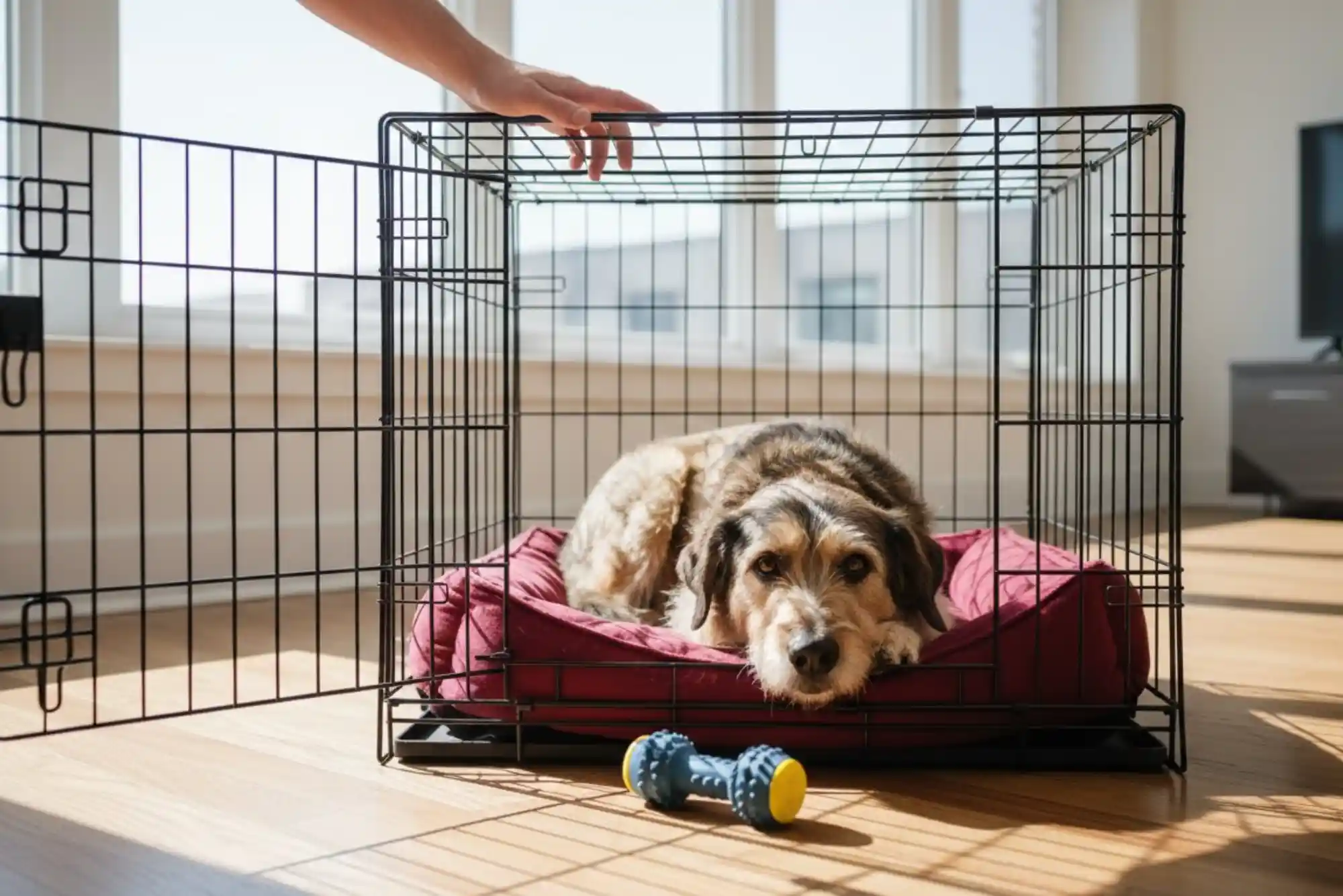
Introduction
Crate training an older rescue dog can be challenging, especially when fear, separation anxiety, or past trauma is involved. A dog that has spent years without a crate may see confinement as frightening rather than comforting. For a rescue dog, the crate may even remind them of a shelter, previous punishment, or another stressful experience.
The good news is that you can crate train an older rescue dog. Age does not prevent dogs from learning new routines. However, when separation fears and phobias are involved, success depends less on forcing the dog to stay inside and more on building trust. Older dogs often need a slower introduction, predictable routines, and plenty of positive experiences before they feel genuinely safe.
Most importantly, a crate should never be treated as a cure for separation anxiety. Some dogs become more distressed when confined, particularly if they panic when left alone. In those cases, a gated room or exercise pen may be safer while you address the underlying anxiety.
Why Crate Training an Older Rescue Dog Can Be Difficult
Puppies usually encounter crates as part of their early routine. An older rescue dog may have a completely different history. They may have been confined for long periods, moved between homes, lived in shelters, or experienced unpredictable treatment.
This history matters because fear is learned through association. If a dog previously experienced confinement as something unpleasant, simply placing them inside a crate can trigger stress.
Separation fears can make the situation more complicated. A dog may tolerate the crate while you are sitting nearby but panic as soon as you walk toward the door. Other dogs may become distressed by the crate itself.

Look closely at what triggers the reaction. If your dog becomes anxious specifically when you leave, separation anxiety may be involved. Signs can include pacing, panting, trembling, barking, destructive behavior, attempts to escape, house-soiling, or refusing food when alone.
Understanding the trigger allows you to choose the right training approach instead of assuming every anxious dog simply needs more crate time.
Rule Out Medical Problems Before Training
Before you begin an intensive crate-training program, consider having an older dog examined by a veterinarian.
Pain, arthritis, sensory decline, cognitive changes, and other medical problems can affect how an older dog responds to confinement and separation. A dog that suddenly becomes anxious at night or starts pacing when previously calm may have an underlying medical issue rather than simply developing a behavioral problem.
This is particularly important for senior rescue dogs. A crate may be physically uncomfortable if the bedding is unsuitable or the dog has difficulty standing, turning, or lying down.
Your goal should be to make the environment both emotionally and physically comfortable before asking your dog to learn something new.
Choose a Comfortable Crate and Location
The crate should be large enough for your dog to stand, turn around, lie down, and change position comfortably. Older dogs may benefit from extra consideration because stiff joints can make movement more difficult.
Place the crate somewhere quiet but not completely isolated. Many dogs feel safer when they can hear or see their family without being in the middle of constant activity.
Some dogs relax better in wire crates because they can see their surroundings. Others prefer a more enclosed environment. There is no universally perfect crate style, so pay attention to your individual dog’s response.
Use comfortable bedding if your dog does not chew or destroy it. You can also provide a safe food-stuffed toy or another enrichment item that your dog already enjoys.
Never use the crate as punishment. If the crate consistently predicts isolation, anger, or unpleasant experiences, it becomes much harder to turn it into a safe space.
Start Crate Training an Older Rescue Dog with the Door Open
The first goal is not to close the door.
The first goal is voluntary entry.
Put the crate in the chosen location and leave the door securely open. Allow your dog to investigate it without pressure. You can place treats near the entrance and gradually move them farther inside as your dog becomes comfortable.
Do not push, pull, drag, or physically place a frightened dog inside.
If your dog approaches the crate, reward that decision. If they put one paw inside, reward them. If they walk all the way in and immediately come back out, that is still progress.
At this stage, your dog is learning a critical lesson: entering the crate does not mean they are trapped.
Older dogs may need several short sessions before they confidently enter. That is completely normal. Positive associations are more valuable than speed.
Make the Crate Predict Good Things
Once your dog willingly enters, start creating stronger positive associations.
You can feed meals near the crate first and eventually move the food bowl inside. Give particularly valuable treats or safe enrichment toys when your dog chooses to spend time inside.
The idea is simple: the crate should predict things your dog genuinely enjoys.
For a rescue dog with fears and phobias, this process can be especially powerful because it gives them control. They are not being forced into an unfamiliar space. Instead, they discover that choosing the crate produces good outcomes.
Continue leaving the door open during this stage. There is no benefit in rushing toward confinement before your dog is emotionally ready.
Introduce the Closed Door Very Gradually
When your dog can relax inside the crate with the door open, you can begin working on the door.
Start by moving the door slightly and immediately returning it to the open position. Reward calm behavior.
Then close it for one or two seconds while you remain right beside the crate. Open it while your dog is still relaxed.
Gradually increase the duration, but do not make every repetition harder. A useful training session might involve a few seconds, then a slightly longer period, followed by another very easy repetition.
This prevents the dog from constantly being pushed toward their anxiety threshold. AKC guidance similarly emphasizes gradual progression and warns against forcing dogs to remain crated beyond their comfort level.
Teach Your Dog That You Can Move Away
A major mistake when you crate train an older rescue dog with separation fears is going directly from “I can close the door” to “I can leave the house.”
Those are completely different skills.
First, close the crate while sitting beside it. Then stand up and sit back down. Take one step away and return. Walk across the room and return. Gradually work toward briefly leaving the room.
Watch your dog’s body language throughout the process.
A relaxed dog may lie down, sniff calmly, chew their enrichment toy, or simply look at you before settling again. An anxious dog may begin pacing, panting, whining, scratching, freezing, repeatedly staring at the door, or abandoning food.
Those signals matter. If anxiety appears, you have probably increased the difficulty too quickly.
Go back to an easier step and rebuild confidence.
Address Separation Anxiety Separately from Crate Training
Crate training and separation-anxiety treatment overlap, but they are not the same thing.
A dog can be perfectly comfortable in a crate while you are home and still panic when you leave. Conversely, a dog may become distressed because the crate itself represents confinement.
For genuine separation anxiety, behavior professionals commonly use gradual desensitization and counterconditioning. The dog experiences very short separations that remain below their panic threshold, while departures become associated with positive experiences.
For example, if your dog becomes anxious when you touch the front door, you might initially walk toward the door and then return without leaving. Later, you might touch the handle, step outside for one second, return, and gradually build from there.
The precise starting point depends on the individual dog.
Do not assume that longer absences automatically make the dog stronger. If your dog repeatedly experiences full panic, the problem can become harder to manage.
Use High-Value Enrichment Carefully
Food can be extremely useful during crate training because it gives the dog something pleasant to anticipate.
A stuffed food toy can help create a positive association with your departure. The ASPCA recommends food-based counterconditioning for appropriate cases of separation anxiety, while emphasizing that the process needs to remain below the dog’s fear threshold.
However, food is not a magic solution.
A severely anxious dog may refuse even their favorite treat when alone. That can be an important clue that the dog is experiencing significant distress rather than simple boredom.
Never leave a toy or chew unattended unless you already know it is safe for your dog.
Watch for Signs You Are Moving Too Fast
Successful crate training should look relatively boring.
Your dog enters. Your dog settles. The door closes. Nothing dramatic happens.
If your dog begins frantic barking, persistent whining, heavy panting, drooling, repeated escape attempts, destructive behavior, or self-injury, stop and reassess.
Escape attempts are particularly concerning. A frightened dog can injure teeth, nails, paws, or other body parts while trying to break out of confinement. Both veterinary and behavior sources caution that crating can worsen severe anxiety in dogs that panic when confined.
In such cases, a puppy-proofed room, baby-gated area, or exercise pen may provide a safer temporary alternative.
The objective is not simply to make the dog stay inside the crate. The objective is to teach the dog that being alone and being confined can be safe experiences.
Build a Predictable Daily Routine
Rescue dogs often benefit from predictability.
Try to keep meals, walks, rest, enrichment, training, and bedtime reasonably consistent. A predictable routine can make the environment easier to understand because the dog begins to know what happens next.
Give your dog physical exercise appropriate for their age and health before training, but avoid exhausting an older dog just to make them tolerate the crate.
Mental enrichment matters too. Sniffing games, food puzzles, gentle training, and relaxed exploration can help provide healthy stimulation.
Crate practice should remain short and successful rather than becoming a daily endurance test.
Never Use “Cry It Out” for a Panicking Rescue Dog
There is an important difference between a dog making a little protest noise and a dog experiencing genuine panic.
If your rescue dog is frantic, trying desperately to escape, or showing intense fear, simply waiting for them to “get over it” is not an appropriate solution.
Fear-based behavior requires careful management and gradual exposure. The ASPCA notes that desensitization and counterconditioning can be complex and recommends professional guidance when anxiety is significant.
If your dog has severe separation anxiety, a qualified force-free trainer, certified separation-anxiety professional, veterinary behaviorist, or veterinarian can help you design an individualized plan.
In some cases, veterinary treatment may be appropriate alongside behavior modification.
How Long Does It Take to Crate Train an Older Rescue Dog?
There is no universal timetable.
Some older dogs become comfortable with a crate within days. Others need weeks or considerably longer, particularly when they have a history of fear, confinement, neglect, or separation anxiety.
The better question is not, “How quickly can I crate train my dog?”
Ask instead, “How quickly can my dog learn this without becoming frightened?”
That change in perspective makes training much more humane and usually more effective.
A dog that progresses slowly but remains relaxed is doing better than a dog that appears to progress quickly but is secretly becoming more distressed.
When a Crate May Not Be the Right Choice
Not every rescue dog needs to be crate trained.
If your dog panics specifically when confined, repeatedly injures themselves attempting to escape, or remains severely distressed despite gradual training, forcing crate use may create more problems.
A safe room, exercise pen, or gated area can sometimes provide the necessary management without adding confinement anxiety.
The crate should be a useful option, not a requirement at all costs.
For some dogs, the most successful outcome is simply learning to relax safely in a larger designated area.
Learning how to crate train an older rescue dog with separation fears and phobias requires patience, observation, and trust. The process should begin with voluntary exploration and positive associations, followed by very short periods of door closure and carefully controlled distance.
Remember that a crate does not automatically treat separation anxiety. For some dogs, it can provide a comforting retreat. For others, confinement intensifies their fear. Your dog’s body language should guide the pace.
FAQs
Can you crate train a dog with separation anxiety?
Yes, but it depends on the individual dog. If the dog already feels safe and relaxed in the crate, it can be part of a broader management plan. If the crate triggers panic, forcing confinement may worsen the problem. Separation anxiety itself usually requires gradual desensitization and counterconditioning.
Can an older dog be crate trained?
Yes. Older dogs can learn to use a crate comfortably. They may require more patience because they have established habits or negative experiences, but age itself does not prevent learning.
How long does it take to crate train an older dog?
It varies widely. Some dogs adapt within days, while others need several weeks or longer. A rescue dog with previous confinement trauma or significant anxiety may need a much slower program. Progress should be measured by calm behavior rather than a fixed number of days.
What if my older dog refuses to go into the crate?
Do not force the dog inside. Leave the door open and begin rewarding voluntary approaches. Put treats or safe enrichment near the entrance and gradually move them farther inside. If your dog remains intensely fearful, professional behavior support may be appropriate.
How do you calm an anxious dog in a crate?
Start by identifying why the dog is anxious. Make the crate comfortable, keep early sessions extremely short, use positive reinforcement, and avoid increasing difficulty while the dog is frightened. If the dog shows panic or attempts to escape, stop the exercise and consult a qualified professional.
Is it cruel to crate train an older dog?
Crate training is not inherently cruel when the crate is introduced positively and used appropriately. Problems arise when a dog is forced into confinement, punished with the crate, or left crated despite obvious distress. Older dogs also need consideration for mobility, comfort, and physical health.
Related Reading: How to Stop a Dog from Barking at Other Dogs on Leash: Reactivity Protocol